by Deborah Howes
May 2025
This talk on envisioning a digital twin to help museums foster more visible, inclusive and meaningful connections across AI-powered platforms was commissioned by the Universities of Rome (Tor Vergata and Tre) for their students enrolled in the Advanced Studies in Heritage Education or Empirical Studies in Museum Education. It is always a pleasure to engage with these students and I look forward to our study day together in Rome on June 27, 2025.
It pains me that the museum sector has not gained more prominence in today’s digital information space after 30+ years of continual effort. Sadly, our spending (collectively) millions of dollars to digitize collections, launch and sustain websites, and/or expand social media impact has not resulted in measurable increases in online or onsite public engagement. Like with many other non-profits, museum digital content gets drowned by dominant algorithms that favor big ad buyers, influencer-generated trends, AI-trained bots, and other invisible factors that control our online experiences today. By the way, this grey cloud of digital brands hovering over an institutional facade is what Chat GPT generated to convey this the sense of messaging overwhelm currently experienced by museums. Even AI gets our predicament.
Nevertheless, the trust and regard the public holds for museums remains steadfast, even as the current federal leaders in the US seek to reduce them. And this gives me hope for museums succeeding in the AI future.
Here’s why:
All that museums have done to make their collections available in digital formats in the past can now be leveraged in new and even more fabulous ways.
To see what I see, let’s envision a digital museum twin:

A “digital twin” is a virtual copy of something real— like a school or a library—that can offer similar, new and/or expanded functions in an exclusively virtual setting. E-books or audio books are digital twins of physical books—the content is very similar but the experience is quite different: the e-book’s text can be enlarged and copied into an e-notebook easily; the audiobook can be used while driving or exercising. Digital content experiences like these are critical alternatives for engaging all visitors, especially those who are neurodivergent or experience barriers when seeing, hearing or moving.
What might a “digital twin” experience of your museum—or one you admire—be like?
Let’s consider these three primary aspects:
the . location . , . structure . , and . experience . of the museum twins. We are going to focus on how a digital twin could make content engagement more accessible to all visitors in each.
. 1. Location .

When planning new analog museums, physical location is paramount. Placing it within population densities—like tourist areas—and adjacent to transportation hubs is essential to facilitate regular and plentiful attendance. Historic houses and remote heritage sites rarely have the luxury of choosing their location, so they often have to work extra hard getting public attention and gaining attendance.
This map of downtown Chicago shows ideal placement for The Art Institute of Chicago: in the center of an urban transportation hub between the Chicago Loop and Grant Park. Whether you are working, studying, shopping or having a leisurely day in the park: the museum is always nearby, which is exactly what the founders planned.
Conversely, the physical location of your museum’s digital twin—e.g., its files, databases, or media storage whereabouts—is absolutely immaterial. In fact, your digital twin’s presence is already experienced by your current website users, social media followers, Wikipedia readers, and YouTube subscribers. All that digital content— including text, links, tags, metadata, and media—comprises a digital twin footprint.
Transforming this footprint into a fully-realized digital twin requires understanding the underlying information structures that Artificially Intelligent systems use to create their “Large Language Models” (LLMs).
. 2. Structure .
Analog museums have solid foundations, secure perimeters, interior climate regulators, controlled lighting, archival storage, classrooms, customized galleries, cafeteria and bathrooms among many other specialized components. Once built, changing this infrastructure is very hard and expensive so getting it right the first time is paramount.

By contrast, the digital twin foundation is built upon something that can—and usually does—change continuously: digital content—meaning assets such as wall labels, images, text, or videos.
Metadata is structured information—like titles, artists, or dates—that helps describe, find, and organize museum objects, whether in databases, books, websites, or files.
What your museum says ABOUT your objects and related files is incredibly valuable metadata. It answers questions like: What year were these objects created? To whom do they belong? What do they depict?
Imagine your museum’s digital assets as piles of tiles intended for a mosaic: each tile or asset could be placed in a variety of contexts depending on the mosaic design, just as you might place items in different exhibitions, publications or web features over the years. The right mosaic expert knows where each tile goes to complete the historic design, but a novice, such as an intern or AI-bot trainee, does not. Novices need information about the design (is it symmetrical? How big is the perimeter?) and the placement of tiles (do I alternate the colors? pair a shape with its opposite?) to complete their tasks. This essential contextual information—like the mortar that holds the tiles into the mosaic pattern—is what will solidify your digital twin foundation. The more usable mortar you have, the stronger the foundation will be. Think of Metadata as the mortar of your digital twin structure.

Here’s some good news: museums regularly produce fabulous metadata about their assets. And even a basic asset management system will contain thousands of descriptions, all organized into field categories and associated with at least one asset. Also, this system will export both the content AND metadata into common formats (like spreadsheets) that AI learning systems can read. In fact, all kinds of metadata can be extracted even from less structured content such as museum catalogs and educational PDFs. If you don’t believe me, ask ChatGPT or Google Notebook to do this work for you.

Let’s look at this very famous American painting from the collection of the Metropolitan Museum of Art created by a German American artist in celebration of the American Revolution. It shows General George Washington’s surprise attack as he led his forces across the Delaware River on Christmas night in 1776.

And here is a diagram showing the basic content and its metadata produced from just the object label. Note that in the white boxes are values that pertain to this object and might also be relevant to others.

For example, perhaps the artist Leutze made other paintings in 1851? Even the title of the work is shared with many other paintings, like this one:

This painting by American artist Robert Colescott was clearly inspired by the Leutze painting. But the overloaded ship is being led by George Washington Carver who was one of the most prominent black scientists in the 20th century. The painting depicts an entirely different, but no less epic, struggle of Black scientists receiving public credit for their work. It seems likely that if you were interested in the Leutze painting you might be interested in seeing the Colescott painting as well. Metadata can make this connection happen.
Here’s a Wikipedia article written about the painting from The Metropolitan Museum of Art’s collection:

Notice the words highlighted in color. These highlights signal to the reader that there are related ideas discussed in other Wikipedia articles. For example, a biography of General George Washington, the geography of the Delaware river, and the timing of the attack on Christmas Day, 1776. We appreciate using Wikipedia because it provides a much larger context for any one particular topic, and that context can also include images, audio files, and videos that are uploaded to the Wikimedia Commons. For qualified, authoritative sources like museums, Wikipedia will make a box of external links that connect directly with your relevant website page.
Large Language Models (LLM) also value Wikipedia, not only for its mind-boggling amount of information (over 1M articles in over 20 languages…), but more importantly for its data structure schema known as WikiData. WikiData was invented more than 10 years ago based on an open data protocol that meshes beautifully with how LLMs learn. Here is a visualization—also known as a knowledge graph—of how this same Wikipedia entry page might look like stored in a Large Language Model:

The lines connecting each of the circles back to the painting represent a relationship between the painting and each circle, known as a node. The aqua colored nodes all describe something ‘depicted’ in the painting (e.g., “longboat,” “soldier”). The dark green nodes on the lower left indicate that the painting was made with canvas and paint), while the navy nodes on the upper left describe its creator and creation date.
Looking at a knowledge graph like this you can well imagine how these nodes can connect for example, to another painting of icebergs, a biography of James Monroe, or something else that was created in 1851. Imagine how many Wikipedia articles reference a “Boat” or a “Soldier” and you can quickly understand the power of WikiData to create an infinitely expandable context for sharing information across the digital landscape of the Internet.

Large Language Models incorporate WikiData into their training and create even larger information maps on top of it. A simple way to embed your museum content into an LLM is to add it to Wikipedia—by writing a new article or adding open content—like copyright-free images, videos or PDFs to the Wikimedia commons.
Make sure all your institutions’ WikiData records are as complete as possible—this will speed up the process of translating your content into other languages.
An (LLM) is a language model, not a knowledge model.
An LLM approximates knowledge by creating an ever-expanding contextual graph of data points that all relate to each other. AI tools train on these models but they do not actually understand the meaning of what they ingest. They make connections between words and ideas, while progressively expanding their data infrastructure. AI agents like Chat GPT do make mistakes and they don’t often realize when they do. One reason I am so keen for museums to contribute their authoritative data to AI language models is to correct these language associations especially as they pertain to topics in the Humanities.
Consider making knowledge graphs from your museum’s authoritative texts, images, and media files intended for public use and license these to LLM makers. In doing so, your data can be attributed, prioritized and presented by AI-powered tools, including Internet searching systems and generative AI agents. More good news: many free generative AI tools can help you create data structures from your asset management system outputs, media files, and PDFs.
Knowledge graphs produced by museums on various topics could prove to be valuable to EdTech firms that are creating AI-enabled textbooks, coaching bots, and the like.
Also, offering your authorized content on lesser known histories, makers, and objects will help correct inherent biases in the LLM learning process that favors white European cultures and achievements.
. 3. Experience .
The benefits of a digital twin having an effective data infrastructure is not only about improving the accuracy and quality of AI learning. It can also greatly improve your museum’s ability to customize, amplify and extend virtual museum experiences.
What is different about visitors engaging with a museum digital twin?

Visiting a physical museum is a wholly intentional, synchronous experience that takes place in a specific location and time. The distinguishing and extraordinary value of this analog museum experience is benefitting from a full range of sensorial and social experiences in the presence of primary source materials—that is, authentic artworks, photographs, objects and documents— that cannot be achieved by any other means.
By contrast, engaging with a museum’s digital twin can happen anywhere, anytime within a variety of digital platforms such as your phone, a laptop, or a VR Headset. Your digital twin can support social components as long as everyone has access to compatible platforms and equipment.
Your digital twin wont have a facade, and visitors may not even know they have entered it. They are likely to encounter it individually as they visit social media streams, YouTube Channels, podcasts, and game sites. Increasingly, digital navigation will be co-piloted through AI agents that draw from the museum’s well-structured data to suggest customized journeys.

The more AI agents know about your museum’s collection and programs, the better they can suggest and support virtual experiences—such as games, immersions, or socializations—available through your museum or another entity.
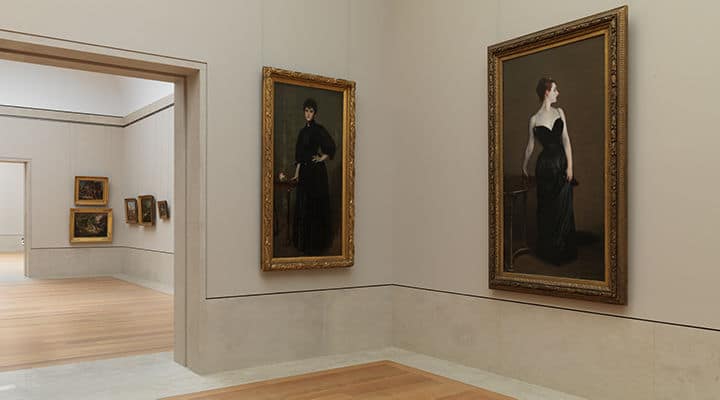
Because these AI-guided experiences are founded on extensive knowledge graphs like WikiData, they can be extended beyond the limit of one museum’s holdings. For example, intelligent agents will soon guide users step-by-step throughout an entire timeline of history, research project, or historical event. Imagine for example, looking for this other famous painting from the Met’s collection shown on the left, known as Madame X by John Singer Sargent. These many nodes are what WikiData allows you to instantly explore regarding this painting. Follow this link to explore how this information map changes dynamically to reveal, for example, who made the dress?, why it inspired a famous gown worn by actress Rita Heyworth? what is known about the real Madam X? and historical reports about the scandal surrounding the painting’s debut.

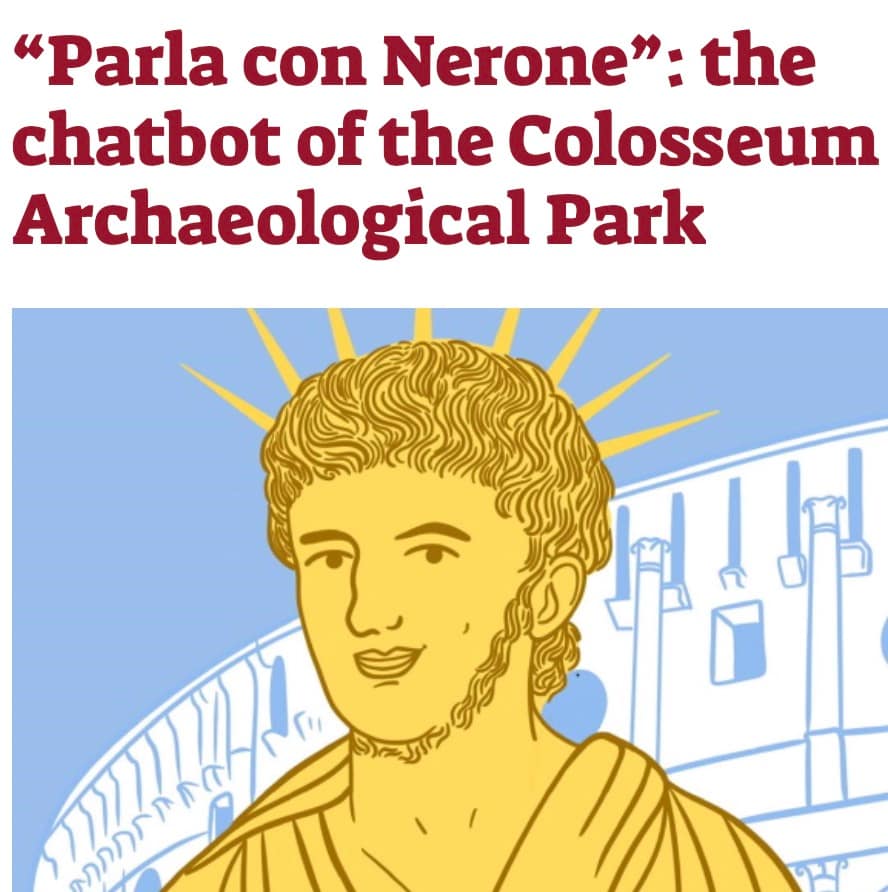
AI agents can even assume personalities from another time period or speak different languages to facilitate your journey. NeroBot helps you navigate the Roman Colosseum website in 3 languages:

A digital experience like this can help you prepare for a physical visit to the site or a lesson on Roman History in class.
NeroBot was innovated by the Colloseo in partnership with the French Edtech company called Ask Mona.
I expect that very soon we will have a full range of AI-powered services designed for use among classrooms, galleries and anywhere, and they will function seamlessly in both virtual or IRL spaces.
Digital transformation is hard work and it begins with engaging people not technology. Here are some words of advice that I hope will facilitate your digital twin adventure:

First, it might be encouraging for your colleagues to learn that the goals of a Digital Twin experience match those of a physical museum experience. Your digital twin should spark curiosity, foster a sense of immersion, offer compelling narratives, and support critical thinking. Judge your success based on these criteria.
Second, taking time for these important steps will help you gain support among your peers:
- Meet regularly in informal ways
- Encourage experimentation
- Discuss ethical issues & making policy
- Share outcomes widely
- Build internal vocabularies & fluencies
I wish you the best of luck!